US Government Shutdown: Fed Flying Blind on Jobs Data as Markets Rally
Introduction
Since October 2, 2025, the United States has been grappling with a major budget crisis. The shutdown—a partial freeze of federal government operations—was triggered by a breakdown in Congressional negotiations. This situation, reminiscent of previous standoffs, has immediate consequences: hundreds of thousands of federal employees are on forced furlough, many public services are suspended, and, for the first time in years, the monthly jobs report has been put on hold.
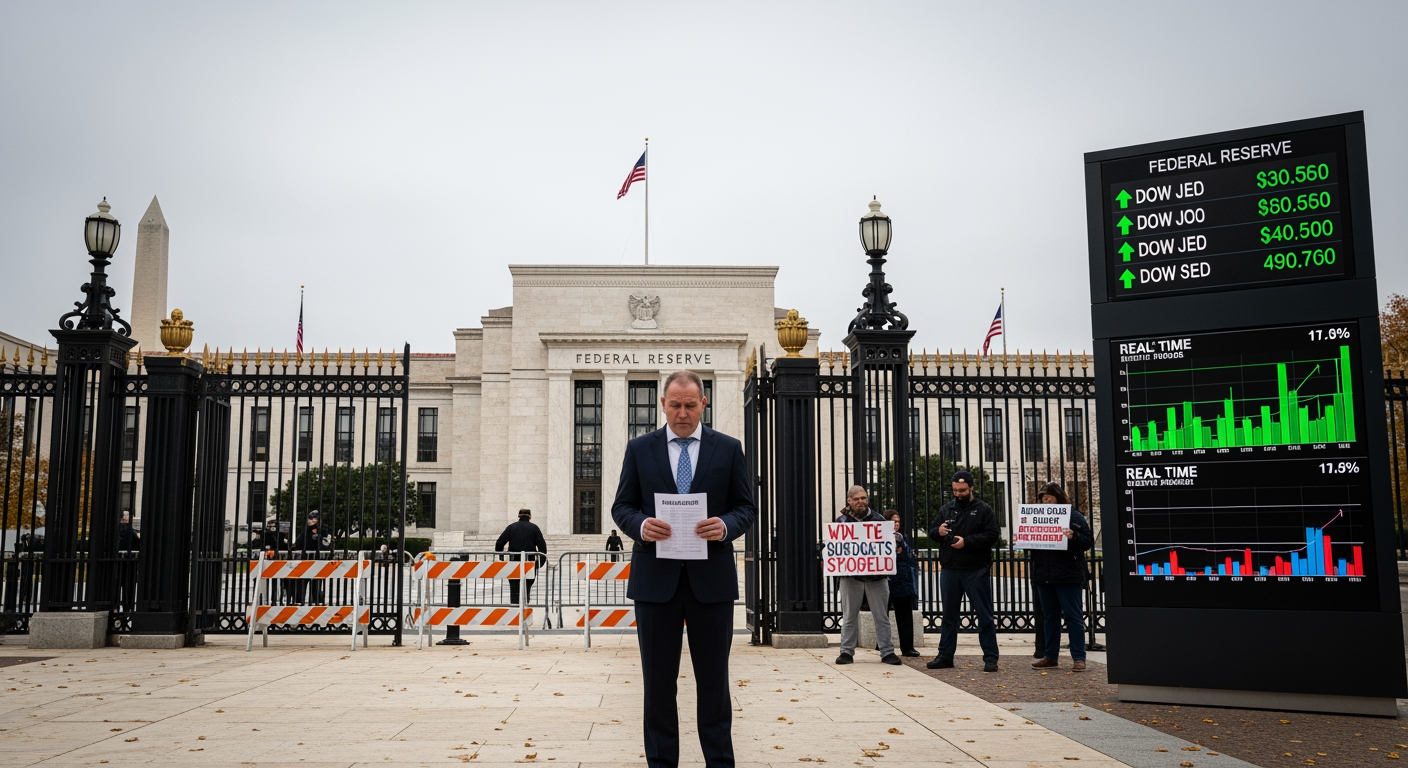
This deadlock comes at a particularly critical moment for the Federal Reserve (Fed). Deprived of key labor market data, the central bank must prepare for its next policy meeting without one of its main economic indicators. Despite the uncertainty, financial markets are showing surprising resilience: Wall Street closed the week on a high note, and expectations for interest rate cuts are gaining momentum.
In this article, we’ll dive into the heart of the story, break down what the shutdown means for the Fed, analyze how markets are reacting, and shed light on the short-term economic outlook.
Understanding the Shutdown: Political Brinkmanship with Real Economic Costs
The current budget paralysis stems from a deep rift between Republicans and Democrats. In the Senate, the failure of another budget vote on Friday, October 3, sealed the shutdown’s extension. The Republican majority is pushing for a budget extension through the end of November, refusing to renew certain social programs demanded by Democrats. With no compromise in sight, the standoff drags on, and leaders don’t expect to reconvene until next week.
As a result, about 750,000 federal employees are furloughed daily, according to the Congressional Budget Office. “Non-essential” services are suspended, affecting everything from cultural institutions to national parks—right in the middle of tourist season. The real-world economic fallout is immediate:
Beyond the day-to-day disruptions, this political standoff is damaging the international reputation of US institutions and fueling doubts about the country’s ability to manage its public finances.
The Fed Without Data: Setting Policy in the Dark
The September monthly jobs report—usually released on the first Friday of the month—didn’t come out this week. This report is one of the Fed’s primary tools for assessing labor market health, wage inflation, and ultimately, steering monetary policy.
Why Are Jobs Numbers So Critical?
For the Fed, the labor market is a fundamental barometer. Changes in the unemployment rate, job creation, and wages guide interest rate decisions. When the economy slows, rising unemployment can justify rate cuts to support growth; conversely, an overheated job market can fuel inflation and prompt caution.
With the shutdown, the Fed is missing what the financial press calls a “major thermometer.” The central bank must now rely on alternative indicators, which are less precise or less frequent, such as weekly jobless claims or private surveys (ADP, ISM). This lack of visibility increases uncertainty and limits the Fed’s ability to anticipate economic swings.
Rate Cut Expectations
Despite the data blackout, markets remain convinced that more rate cuts are on the way. Several factors are driving this belief:
According to the latest analysis from Bloomberg and Reuters, a 25-basis-point cut at the Fed’s next meeting is now priced in by most investors. This expectation is reinforced by the cautious tone adopted by Fed Chair Jerome Powell in his recent public remarks.
Equities Rally: Markets Climb Despite the Uncertainty
While many feared a market correction, US indexes ended the week higher. The Dow Jones rose 1.2%, the S&P 500 gained 1.6%, and the Nasdaq jumped 2.1% for the week. This strong performance may seem surprising, but several factors are at play.
Why Are Markets Rising?
According to EDRAM, fund managers are betting the rally will continue if the political crisis is resolved quickly. On the flip side, a prolonged shutdown could eventually weigh on confidence and trigger a correction.
Which Sectors Are Most Affected?
Political Stalemate: Congress at an Impasse
Congress is locked in a blame game, with each side accusing the other of irresponsibility. Republicans, led by Donald Trump, are demanding deep cuts to social programs, while Democrats refuse any deal without guarantees on healthcare and aid for the most vulnerable. The deadlock is total: only three Democrats backed the latest Republican proposal—far short of the 60 votes needed to pass the budget.
The White House, through spokesperson Karoline Leavitt, accuses the opposition of holding the government hostage. Democrats, for their part, call the shutdown a political ploy and warn of mass layoffs if the situation drags on.
A Washington Post poll shows a divided public: 47% of Americans blame Donald Trump and the Republicans, while 30% point the finger at Democrats. This political polarization is fueling uncertainty and making it harder to break the deadlock.
Immediate and Medium-Term Economic Impacts
Impact on Growth
Past shutdowns have shown that each week of paralysis shaves between 0.1 and 0.2 percentage points off US GDP growth. The record 35-day shutdown in 2018-2019 cost 0.3 points, according to the Congressional Budget Office. If the current crisis drags on for “several weeks,” as some analysts fear, Q4 2025 could start in negative territory.
Effects on Households and Businesses
Businesses—especially those dependent on government contracts (construction, security, healthcare)—are already facing project cancellations or delays. Consumer confidence, as measured by the Conference Board, has dipped slightly since the start of the week.
Risks to Financial Stability
A prolonged shutdown could trigger a market correction if confidence collapses. For now, Wall Street’s “fear index,” the VIX, remains subdued, but it could spike if the gridlock continues.
Outlook and Key Trends to Watch
How Could the Crisis End?
Several scenarios are possible:
Fed Decisions Under the Microscope
The Fed’s next meeting, set for October 29, will be closely watched. Investors are looking for clear signals on rate direction, but the lack of jobs data complicates the Fed’s job. Jerome Powell, sticking to his cautious approach, is likely to stress flexibility and the Fed’s data-dependent stance. Rate cuts remain the base case, but the speed and scale of any move will depend on how the shutdown is resolved.
Markets: More Rally Ahead or a Correction Coming?
For now, stocks remain on an upward trend, but volatility could pick up. Defensive sectors (healthcare, energy) should hold up better, while tech and financials may see more swings. International investors are staying on the sidelines, watching the dollar and US rates closely.
Conclusion
The US government shutdown of fall 2025 has put the world’s largest economy in a tough spot, with the Fed flying blind on key indicators and markets moving counter to institutional uncertainty. While Wall Street’s resilience reflects confidence in a quick resolution, the risk of a prolonged crisis shouldn’t be underestimated. The coming weeks will be crucial—not just for US fiscal policy, but for the direction of global monetary policy as well.
Whether you’re an investor or just following the news, it’s important to stay alert: keep an eye on Congressional developments, Fed statements, and alternative indicators. The shutdown isn’t just about politics—it’s a symptom of a fractured American society, and the choices made now will have ripple effects far beyond US borders.
---
Category: macroeconomics | Keywords: shutdown, Fed, labor market, interest rates, equities (Main sources: Le Monde, Boursorama, Bloomberg, Reuters, EDRAM, Washington Post, Congressional Budget Office, Conference Board, as of October 4, 2025)---
❓ FAQ - Frequently Asked Questions
1. What is a US government shutdown and why did this one happen?
A US government shutdown is a partial freeze of federal operations when Congress fails to pass a budget or temporary funding. In the current case, a breakdown in negotiations led to the shutdown’s extension after a failed Senate vote on Friday, October 3. The Republican majority is pushing for a budget extension through the end of November while refusing to renew certain social programs demanded by Democrats. With no compromise in sight, leaders don’t expect to reconvene until next week. As a result, many public services are suspended, hundreds of thousands of federal employees are furloughed, and, unusually, the monthly jobs report has been put on hold.
2. How is the shutdown affecting daily life and public services?
About 750,000 federal employees are being furloughed daily, and “non-essential” services are suspended. Major tourist sites such as the Washington Monument are closed, and administrative services—including passport processing and social assistance applications—are halted. The immediate fallout includes a hit to household sentiment and local spending, coming during tourist season. Beyond these disruptions, the episode is damaging the international reputation of US institutions and fueling doubts about the country’s ability to manage public finances.
3. Why is the Fed said to be “flying blind,” and why are jobs numbers so important?
The monthly jobs report—typically released on the first Friday—didn’t come out due to the shutdown. This report is a primary tool for the Federal Reserve to gauge labor market health: unemployment, job creation, and wages inform interest rate decisions. When unemployment rises, rate cuts may support growth; when the job market overheats, inflation risks prompt caution. Lacking this “major thermometer,” the Fed must rely on alternative indicators that are less precise or frequent. That raises uncertainty and limits its ability to anticipate economic swings ahead of its next policy meeting.
4. What data can the Fed use while the jobs report is on hold?
In the absence of the official jobs report, the Fed can look to higher-frequency or private indicators, such as weekly jobless claims and private surveys like ADP and ISM. However, the article underscores that these are less precise or less frequent than the comprehensive monthly employment release. As a result, policy decisions made on these proxies come with more uncertainty and reduced visibility on key labor dynamics like wage growth and broad-based hiring trends.
5. Are interest rate cuts expected despite the data blackout?
Yes. Markets are pricing in more rate cuts, with Bloomberg and Reuters noting that a 25-basis-point cut at the next Fed meeting is now the base case for most investors. Several factors underpin this view: a global economic slowdown in Q3 2025, mixed signals on US consumer spending, and budget tensions that could weigh on growth into Q4. The cautious tone adopted by Fed Chair Jerome Powell in recent remarks further reinforces expectations for monetary easing.
6. How might the shutdown shape the Fed’s October 29 meeting?
The October 29 meeting will be closely watched for guidance on rates, but the missing jobs report complicates the Fed’s job. Jerome Powell is likely to stress flexibility and the central bank’s data-dependent stance. While rate cuts remain the base case, the speed and scale of any move will depend on how the shutdown is resolved and whether key data become available in time. In short, the policy message may emphasize caution, optionality, and sensitivity to evolving conditions.
7. Why are stocks rallying even as the government is shut down?
US equities ended the week higher (Dow +1.2%, S&P 500 +1.6%, Nasdaq +2.1%). The article cites three drivers: anticipation of rate cuts that support risk asset valuations; early October earnings showing large companies protecting margins; and investors using volatility to buy perceived bargains. According to EDRAM, fund managers expect the rally to continue if the political crisis is resolved quickly. However, a prolonged shutdown could hurt confidence and trigger a market correction.
8. Which sectors are most affected or resilient right now?
Financials are cautious amid volatility but could benefit from lower rates that support lending. Technology is leading gains—helped by tech giants and investment in artificial intelligence, seen as less sensitive to budget cycles—boosting the Nasdaq’s outperformance. Consumer-related stocks are more volatile due to fears of slowing demand. Looking ahead, defensive areas such as healthcare and energy should hold up better, while tech and financials may experience larger swings if volatility rises.
9. What are the immediate and medium-term economic impacts of the shutdown?
Past shutdowns suggest each week of paralysis shaves 0.1–0.2 percentage points off US GDP growth. The 35-day shutdown in 2018–2019 cost 0.3 points. If the current crisis lasts “several weeks,” Q4 2025 could start in negative territory. Households face delays in social assistance payments and lost income for affected federal workers; federally backed loan applications are suspended; and real estate markets and IRS operations are disrupted. Businesses reliant on government contracts are already seeing project delays or cancellations. Consumer confidence has dipped slightly since the week began. Financial stability risks could rise if confidence collapses: the VIX is subdued for now, but could spike if gridlock persists.
10. How could the crisis end, and what would each outcome mean?
The article outlines three scenarios. Last-minute deal: Congress compromises, services resume, and the Fed regains access to data before its late October meeting. Prolonged shutdown: paralysis continues, forcing the Fed to decide with limited visibility and making markets jittery. Political escalation: new threats of layoffs and budget cuts deepen polarization, with lasting effects on growth. Each path carries different implications for confidence, market volatility, and the timing of any Fed policy moves.
11. What are the key political dynamics and how is the public reacting?
Congress is at an impasse, with Republicans—led by Donald Trump—seeking deep cuts to social programs and Democrats refusing any deal without guarantees on healthcare and aid for vulnerable groups. Only three Democrats backed the latest Republican proposal, well short of the 60 votes needed. The White House, via spokesperson Karoline Leavitt, accuses the opposition of holding the government hostage; Democrats call the shutdown a political ploy and warn of mass layoffs if it drags on. A Washington Post poll shows 47% of Americans blame Donald Trump and Republicans, while 30% blame Democrats, underscoring deep polarization.
12. What should investors watch in the coming weeks?
The article advises staying alert to Congressional developments, Fed statements, and alternative indicators (weekly jobless claims, ADP, ISM). Markets are currently resilient, but volatility could pick up: the VIX is subdued now and could spike if the gridlock continues. Sector-wise, defensive areas like healthcare and energy should hold up better, while technology and financials may see more swings. International investors are waiting on the sidelines, monitoring the dollar and US rates. EDRAM notes the rally could continue if the political crisis resolves quickly; a prolonged shutdown could erode confidence and trigger a correction.