Take-Two Interactive Drops 8% After GTA VI Delay: How a Blockbuster Shapes Valuation and Market Dynamics
Introduction: A Market Shock Triggered by the GTA VI Delay
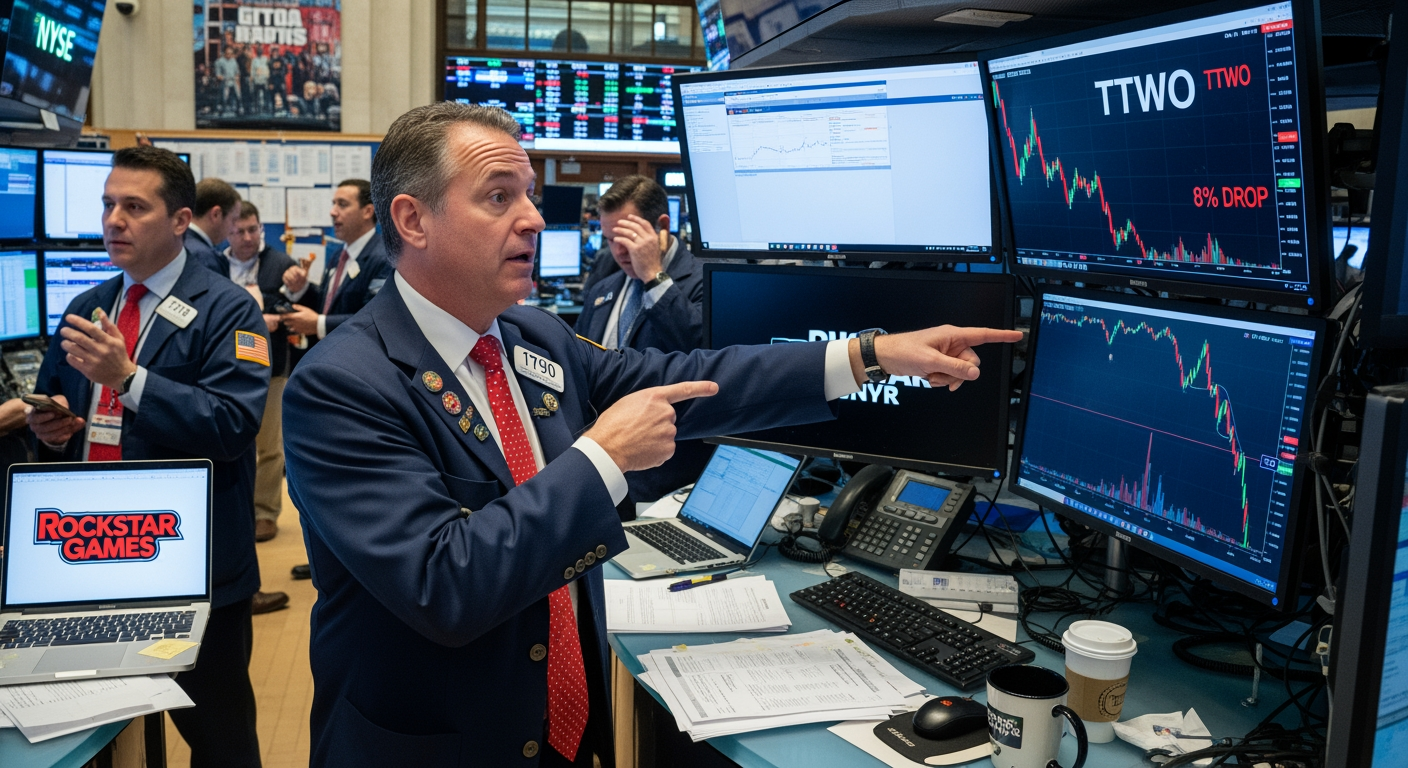
On November 8, 2025, both the financial and gaming worlds were rocked by major news: Take-Two Interactive, parent company of Rockstar Games, saw its stock plunge over 8% to $232.00 after announcing a delay in the release of Grand Theft Auto VI (GTA VI)—one of the most highly anticipated games of the decade. This sharp drop wasn’t just a technical blip; it underscored the industry’s heavy reliance on blockbuster launches and the extreme sensitivity of investors to publishers’ release schedules.
Why does a delay announcement trigger such a seismic reaction? Because GTA VI, originally slated for early fiscal 2026, was expected to be the growth and profitability engine for Take-Two, whose valuation is largely built on the success of its flagship franchises. This situation highlights the sector’s economic structure, market psychology, and the stakes for shareholders in the era of gaming blockbusters.
In this article, we’ll break down the fallout from the delay, explore what drives the valuation of publishers like Take-Two, and analyze the medium-term outlook for the market, investors, and the video game industry as a whole.
---
Publishers’ Reliance on Blockbusters: GTA VI as a Case Study
GTA VI: An Economic Phenomenon Beyond Gaming
GTA VI isn’t just another entertainment product—it’s an economic juggernaut. Since GTA V launched in 2013, the franchise has sold over 185 million copies across all platforms, generating more than $8 billion in revenue. Expectations for GTA VI are sky-high: analysts projected a launch capable of bringing in several billion dollars in its first year alone, with major impacts on revenue, operating margins, and market valuation.
Blockbusters like GTA, Red Dead Redemption, and NBA 2K account for the bulk of Take-Two’s recurring revenue. According to the publisher’s most recent financial report for fiscal Q2 2025, flagship franchises made up nearly 81% of "Net Bookings"—the net amount of product and service sales, including digital revenue, in-game purchases, and merchandising.
A High-Stakes but Unavoidable Strategy
For Take-Two, betting on its major franchises is a double-edged sword:
This business model, common throughout the gaming industry, exposes publishers to strong cycles: revenue visibility hinges on release dates, and every delay directly impacts financial projections, investor confidence, and valuation.
---
Key Numbers: The Immediate Impact on Valuation and Financial Performance
Stock Price Plunge: A Clear Signal
On November 8, Take-Two Interactive’s stock closed at $232.00, down 8.08% for the day, according to data from Boursorama and AFP. This move signals a loss of market confidence, with investors bracing for downward revisions to growth forecasts for the current fiscal year.
To put it in perspective:
Financial Performance: Solid Results Under Pressure
Take-Two’s latest financial report, released in early November 2025, showed moderate growth:
Recurring revenue (microtransactions, additional content) remains strong, but investors are looking for a real rebound with the launch of GTA VI, now pushed back to fall 2026 based on Take-Two’s internal projections.
---
Why the Delay? Creative Ambition Meets Corporate Caution
Why Did Rockstar Games Delay GTA VI?
Developing GTA VI is a massive undertaking: more than 600 developers, an estimated $1 billion budget, and unprecedented technical and narrative challenges. Rockstar and Take-Two cited several reasons for the delay:
Industry trends favor caution: gamers expect a polished, finished product, and even minor missteps can be costly in terms of reputation and sales.
Is This the New Normal for the Industry?
Delays for blockbuster titles have become more common in recent years:
This trend may become the new standard for major publishers, who are prioritizing quality over speed—even if it means sacrificing short-term visibility.
---
The Fallout for Investors and the Market
Investor Reaction: Volatility and Portfolio Shuffling
The GTA VI delay triggered major volatility for Take-Two’s stock—and across the sector:
Financial analysts revised their price targets:
Impact on Earnings Projections
The GTA VI delay forces Take-Two to revise its guidance for fiscal 2026:
For shareholders, patience is key: the upside potential is still there, but the timeline has stretched and short-term visibility has diminished.
---
The Weight of Major Releases in Publisher Valuations
A Highly Concentrated Business Model
The video game industry relies on a handful of titles for most of its revenue:
This concentration heightens publishers’ dependence on commercial hits:
How Investors Manage Risk
To limit volatility, investors focus on:
The Take-Two case is a reminder that publisher valuations are highly sensitive to release schedule news, and that timing management is as strategic as creative development.
---
What’s Next for Take-Two and the Gaming Industry?
Take-Two: A Leader Under the Microscope
Despite the stock correction, Take-Two still has major strengths:
The company is forecasting a massive rebound in 2026, with the launches of GTA VI, Borderlands 4, and Mafia: The Old Country, according to its latest investor communications. The potential for value creation remains high—provided Take-Two can manage both its schedule and launch quality.
Industry Trends: Toward a More Mature, Demanding Market
The gaming sector is evolving:
For investors, this means:
---
Conclusion: A Delay That Reveals Deeper Industry Dynamics
The GTA VI delay and Take-Two Interactive’s 8% stock drop show just how much the video game industry has become a blockbuster-driven market, where every major announcement is scrutinized by investors and analysts alike.
For Take-Two, the challenge isn’t just launching the next hit—it’s managing the transition to a more mature industry, where quality trumps speed and valuation depends on the ability to build a global community around its franchises.
For investors, this case is a reminder that patience and diversification are the best defenses against sector volatility, while keeping a close eye on development cycles and strategic announcements.
And for gamers and fans, the wait for GTA VI matches the scale of the event: we’ll have to hold out until fall 2026 to experience one of the most ambitious games ever made, in a market that’s more competitive, innovative—and unpredictable—than ever.
---
❓ FAQ - Frequently Asked Questions
1. What happened to Take-Two’s stock and why did it drop 8%?
On November 8, 2025, Take-Two Interactive’s stock fell 8.08% to $232.00 after the company announced a delay to Grand Theft Auto VI (GTA VI). The selloff reflected investors’ concern that GTA VI—expected to be the key growth and profitability driver—would now contribute later than planned. Before the announcement, Take-Two’s market cap was around $26 billion; the 8% decline erased nearly $2 billion in value in a single day. Trading volume spiked, signaling heightened anxiety and expectations for downward revisions to growth forecasts for the current fiscal year. The reaction underscores how sensitive publisher valuations are to release schedules in a blockbuster-driven industry.
2. When is GTA VI now expected to launch?
Based on Take-Two’s internal projections, GTA VI has been pushed back to fall 2026. It was originally slated for early fiscal 2026. The company and Rockstar Games indicated that the delay aligns with creative, quality, and commercial considerations. For gamers, the article notes we’ll have to wait until fall 2026 to experience the game.
3. Why does a delay hit a game publisher’s valuation so hard?
Publishers like Take-Two rely heavily on a few blockbuster franchises for growth and profitability. Revenue visibility hinges on release dates; when a tentpole slips, the timing of cash flows, margin leverage, and investor confidence all shift. The model is a double‑edged sword: it offers huge upside when launches land, but creates extreme volatility if they’re delayed or underperform. As a result, delay announcements often trigger immediate stock corrections and valuation downgrades.
4. How big is the GTA franchise economically?
Since GTA V launched in 2013, the franchise has sold over 185 million copies across all platforms and generated more than $8 billion in revenue. Expectations for GTA VI are extremely high: analysts projected a launch capable of bringing in several billion dollars in its first year alone, with significant impacts on revenue, operating margins, and market valuation. That scale explains why schedule changes around GTA VI have outsized market effects.
5. What are “Net Bookings,” and how reliant is Take-Two on its flagship franchises?
Net Bookings are the net amount of product and service sales, including digital revenue, in‑game purchases, and merchandising. According to Take-Two’s fiscal Q2 2025 report, flagship franchises accounted for nearly 81% of Net Bookings. This concentration highlights the central role of blockbuster series like GTA, Red Dead Redemption, and NBA 2K in driving recurring revenue and overall performance.
6. What did Take-Two report in its latest quarter?
In early November 2025, Take-Two reported fiscal Q2 2025 results showing moderate growth: Net Bookings of $1.47 billion (+2% year over year), GAAP Net Revenue of $1.35 billion (+4% year over year), and a net loss of $365.5 million (or $2.08 per share), an improvement over the prior year. Recurring revenue from microtransactions and additional content remains strong, but investors are looking for a fuller rebound tied to GTA VI—now pushed to fall 2026.
7. Why did Rockstar Games delay GTA VI?
Rockstar and Take-Two cited three main factors: creative ambition (delivering a groundbreaking open world with major technical and narrative advances), quality control (avoiding the pitfalls of rushed launches), and commercial optimization (targeting a prime fall launch window). The project’s scale—more than 600 developers, an estimated $1 billion budget, and a 5–8 year development cycle—adds complexity that favors caution.
8. Are long delays becoming the new normal for blockbuster games?
Yes, delays have become more common. Development cycles are lengthening, technical complexity is rising with next‑gen consoles and PC, and player expectations are higher than ever. Major publishers are increasingly prioritizing quality over speed, even at the cost of short‑term visibility. This trend reflects a more mature market where polished releases are essential to protect brand equity and long‑term sales.
9. How did investors and analysts react to the delay?
The announcement sparked sector-wide volatility. Take-Two shares dropped sharply, and competitors like Electronic Arts and Ubisoft also saw swings as investors recalibrated expectations. Specialized funds adjusted their exposure—some cut Take-Two positions, while others positioned for a medium‑term rebound. On Wall Street, Morgan Stanley downgraded Take-Two to “neutral,” citing growth pushed back a fiscal year, whereas Goldman Sachs remained bullish on the long‑term potential, anticipating a record‑setting 2026 launch.
10. What’s the expected impact on near‑term revenue and margins?
Analysts expect Take-Two’s current‑year revenue to fall $500 million to $1 billion short of initial forecasts due to the GTA VI delay. Without a new blockbuster to drive operating leverage, margins are likely to be squeezed. The company’s guidance for fiscal 2026 will need to reflect this timing shift, reinforcing the importance of schedule management for valuation.
11. What should investors do now to manage risk in gaming stocks?
The article emphasizes patience and diversification. Investors can mitigate volatility by spreading exposure across publishers and sectors, closely analyzing release calendars and development pipelines, and balancing short‑term valuation with long‑term potential. In a market that scrutinizes delay and launch announcements, a long‑term approach centered on quality, player retention, and innovation is key.
12. What’s next for Take-Two, and what could drive a rebound?
Despite the correction, Take-Two retains major strengths: leading franchises (GTA, Red Dead, NBA 2K), strong innovation capacity and player loyalty, and a solid financial base with growing recurring revenue. The company is forecasting a massive rebound in 2026 with the launches of GTA VI, Borderlands 4, and Mafia: The Old Country, per its latest investor communications. The upside remains high—provided Take-Two executes on schedule management and launch quality.