Pakistan: Balance of Payments Surplus and Rising Migrant Remittances
Introduction
As 2025 draws to a close, Pakistan is experiencing a major macroeconomic shift: the return to a balance of payments surplus. This development is especially noteworthy as it comes hand-in-hand with a significant increase in migrant remittances, helping to bolster the country’s financial stability, support the rupee, and restore investor confidence. In a tense global environment and after years of chronic deficits, this turnaround is generating both hope and caution among policymakers and market participants alike.
Why does this reversal matter so much right now? Because the balance of payments, a true barometer of a country’s economic relations with the rest of the world, is crucial to the overall health of Pakistan’s economy. It determines the nation’s ability to import goods, service its debt, finance investment, and maintain currency stability. Pakistan is only just emerging from a period marked by intense pressure on the rupee, high inflation, and strained foreign exchange reserves.
In this article, we’ll break down the latest figures, analyze the key drivers behind this positive shift, and explore the real-world implications for Pakistan’s economy, its markets, and its partners. We’ll also outline the challenges and outlook for 2026.
---
A Historic Turnaround in the Balance of Payments
Key Figures for September 2025
The latest weekly report from Islamabad’s Economic Service confirms it: Pakistan posted a $77 million balance of payments surplus in September 2025, a dramatic improvement from the $347 million deficit recorded in the same period in 2024. For the first quarter of the 2026 fiscal year (July to September 2025), the balance is also positive at $274 million, compared to a $383 million deficit a year earlier.
This momentum is partly due to a $110 million current account surplus in September, versus a $52 million deficit in September 2024. The financial account has also improved, with a $151 million surplus in September, compared to a cumulative quarterly deficit of $527 million—significantly better than the $921 million deficit in the same quarter of the previous year.
These changes are particularly remarkable given the challenging regional and global backdrop: geopolitical tensions, slowing international trade, volatile emerging market currencies, and uncertainty over commodity prices.
Comparison with Previous Years
Since 2018, Pakistan has regularly faced substantial balance of payments deficits, which have put pressure on foreign exchange reserves and required multiple IMF interventions, notably through the Extended Fund Facility. In 2023 and 2024, external debt and debt servicing weighed heavily on the country’s accounts, forcing the government to adopt strict fiscal and monetary measures.
The return to surplus at the end of 2025 marks a break from this period of chronic vulnerability. It’s the first quarterly balance of payments surplus in several years, strengthening the credibility of ongoing reforms and the country’s ability to meet its international obligations.
---
Migrant Remittances: A Key Pillar of Stability
Double-Digit Growth
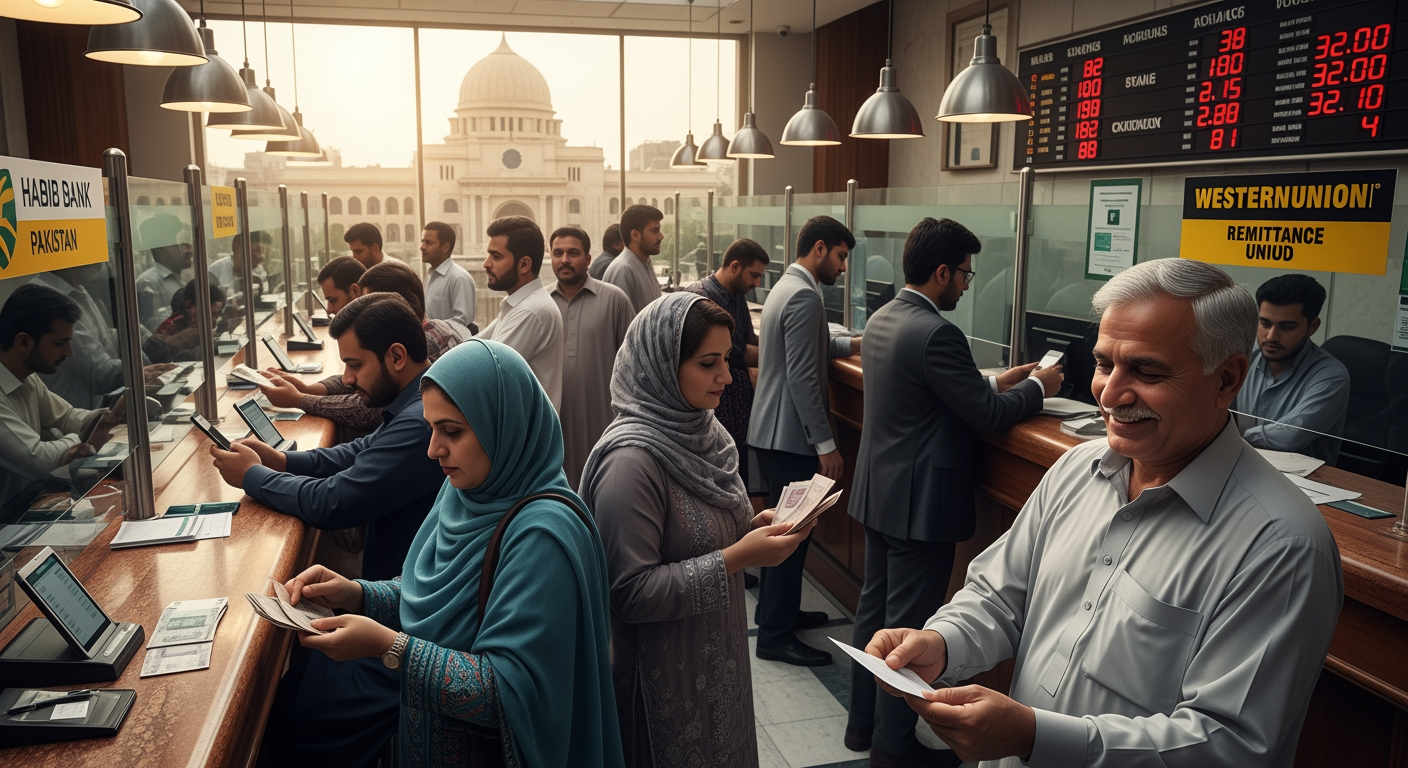
At the heart of this improvement, migrant remittances are playing a decisive role. In September 2025, remittances reached $3.2 billion, up 11% from the same period last year. For the quarter, they totaled $9.5 billion, an 8.4% year-over-year increase. These flows, mainly sent by the Pakistani diaspora in the Middle East, Europe, and North America, are a vital source of foreign currency for the economy.
The rise in remittances can be attributed to several factors:
A Buffer Against External Shocks
Migrant remittances are crucial for several reasons:
According to the State Bank of Pakistan (SBP), these remittances have helped offset the structural trade deficit, especially as imports have started to rise again (+6.3% in September year-over-year) due to recovering domestic demand and higher prices for certain inputs.
---
Exports, Imports, and Sectoral Momentum
Exports on the Rise, Gradual Diversification
Pakistani exports grew by 4.5% in September 2025, reaching $3.43 billion. For the quarter, exports totaled $10.1 billion, up 8.2% from last year. This growth is driven by:
Imports: A Controlled Rebound
Imports rose 6.3% in September, reaching $6 billion—a sign of recovering domestic demand after several quarters of contraction. For the quarter, imports totaled $18.5 billion, compared to $17.1 billion in the same period last year.
The increase in imports is mainly in:
This controlled rebound in imports, coupled with export growth, is helping to limit the widening of the trade deficit, which nonetheless remains a structural issue.
---
Foreign Direct Investment and Financial Flows
FDI: A Weak Spot
Despite the balance of payments surplus, foreign direct investment (FDI) has seen a notable decline. In September 2025, net FDI stood at $186 million, down from $417 million a year earlier. For the quarter, FDI reached $569 million, compared to $864 million in the previous year.
This drop is due to:
Nevertheless, China, Hong Kong, Switzerland, and the UK remain among the top investors, especially in infrastructure and technology.
Financial Account and Investment Appeal
The financial account, which tracks all capital flows (loans, portfolio investments, etc.), posted a $151 million surplus in September. For the quarter, the deficit narrowed from $921 million to $527 million, reflecting improved sovereign risk perception and greater fiscal discipline.
The improved balance of payments and renewed rupee stability could, over the medium term, make Pakistan more attractive to foreign investors—particularly those seeking higher returns in frontier markets.
---
Impact on the Currency and Investor Confidence
The Rupee on the Path to Stability
The stabilization of the balance of payments has eased pressure on the Pakistani rupee, which had suffered a sharp depreciation in 2022 and 2023, losing over 30% of its value against the dollar in a single year. In 2025, the currency has stabilized, helped by rising remittances and a rebound in foreign exchange reserves.
This stability is crucial for:
Investor Sentiment and Market Outlook
The return to a balance of payments surplus is sending a positive signal to both institutional and individual investors:
However, this renewed confidence remains fragile and depends on continued reforms, inflation control, and political stability.
---
Ongoing Challenges and Outlook
Structural Challenges Ahead
Despite these gains, Pakistan still faces several major challenges:
Levers to Sustain Progress
To turn this cyclical improvement into lasting progress, several strategies should be prioritized:
Outlook for 2026
If the positive trends in remittances and exports hold—and assuming continued domestic political stability—Pakistan could maintain a balanced or even surplus balance of payments in 2026. This would help build up foreign reserves, stabilize the currency, and strengthen the economy’s resilience to external shocks.
However, a reversal in commodity prices, a slowdown in remittances, or worsening geopolitical tensions could put this trajectory at risk.
---
Conclusion
The return to a balance of payments surplus and the surge in migrant remittances mark a turning point for Pakistan’s economic trajectory. These positive signals reflect greater resilience to external shocks and offer a welcome window of stability after several turbulent years. If this momentum continues, it could pave the way for more balanced and inclusive growth—provided the country can overcome persistent structural challenges.
For investors, businesses, and policymakers, the challenge now is to turn this short-term rebound into lasting progress by focusing on innovation, diversification, and harnessing the power of the diaspora. As 2025 ends, Pakistan is entering a critical phase for its economic future.
---
❓ FAQ - Frequently Asked Questions
1. What is the balance of payments and why does it matter for Pakistan right now?
The balance of payments (BoP) is described in the article as a barometer of a country’s economic relations with the rest of the world. It determines Pakistan’s ability to import goods, service its debt, finance investment, and maintain currency stability. After years of chronic deficits that pressured the rupee, boosted inflation, and strained foreign exchange reserves, Pakistan’s return to a surplus at the end of 2025 marks a turning point. It is the first quarterly BoP surplus in several years and strengthens the credibility of reforms and the country’s ability to meet international obligations. This matters now because stabilizing external accounts supports the rupee, bolsters foreign exchange buffers, and helps restore investor confidence at a time of global uncertainty, geopolitical tensions, and volatile commodity and currency markets.
2. What do the latest figures show about Pakistan’s surplus?
According to Islamabad’s Economic Service, Pakistan posted a $77 million balance of payments surplus in September 2025, a sharp reversal from a $347 million deficit in September 2024. For the first quarter of the 2026 fiscal year (July–September 2025), the balance is also positive at $274 million, compared with a $383 million deficit a year earlier. The current account swung to a $110 million surplus in September (versus a $52 million deficit in September 2024). The financial account recorded a $151 million surplus in September; on a quarterly basis, its deficit narrowed to $527 million from $921 million in the prior year’s quarter. These improvements occurred despite a challenging global backdrop marked by geopolitical tensions, slowing trade, volatile emerging market currencies, and commodity price uncertainty.
3. What are migrant remittances and how are they supporting stability?
Migrant remittances are funds sent home by Pakistanis living abroad, mainly in the Middle East, Europe, and North America. They are a vital source of foreign currency. In September 2025, remittances reached $3.2 billion, up 11% year over year; for the quarter, they totaled $9.5 billion, an 8.4% increase. Remittances reduce the need for external financing, support local household consumption, and help limit rupee volatility by raising foreign currency supply in the domestic market. They have also helped offset the structural trade deficit, especially as imports rose 6.3% year over year in September with domestic demand recovering. The rise in remittances reflects stable expatriate employment (notably in Gulf countries), favorable exchange rate effects that encourage transfers, and more digitalized, secure transfer channels that make sending money home faster and easier.
4. How are exports and imports evolving, and which sectors are driving changes?
Exports grew 4.5% in September 2025 to $3.43 billion, and reached $10.1 billion for the quarter, up 8.2% year over year. This momentum is led by textiles (benefiting from strong demand in Europe and the United States), the agri-food sector (helped by favorable harvests), and IT services, which hit a record $366 million in September. Imports rose 6.3% in September to $6 billion, reflecting a rebound in domestic demand after prior contractions; for the quarter, imports were $18.5 billion versus $17.1 billion a year earlier. The increase is concentrated in industrial raw materials, capital goods, and certain food products. While the trade deficit remains a structural issue, the combination of export growth and robust remittance inflows is helping to limit its widening as domestic activity gradually recovers.
5. Why is foreign direct investment (FDI) still a weak spot?
Despite the overall balance of payments surplus, FDI has declined. Net FDI in September 2025 was $186 million, down from $417 million a year earlier; for the quarter, it totaled $569 million versus $864 million previously. The article attributes this to a wait-and-see stance among foreign investors amid regional geopolitical volatility, uncertainty over tax policy and regulatory stability, and a shift of capital flows toward other emerging markets seen as less risky. Nonetheless, China, Hong Kong, Switzerland, and the UK remain among the top sources of investment, particularly in infrastructure and technology. The weakness in FDI underscores that, beyond short-term improvements in external accounts, Pakistan needs to strengthen the investment climate to sustainably finance development and reduce reliance on more volatile forms of external financing.
6. What does the financial account indicate about capital flows and sentiment?
The financial account captures capital flows such as loans and portfolio investments. In September, it showed a $151 million surplus, and on a quarterly basis its deficit narrowed to $527 million from $921 million a year earlier. The article links this improvement to better sovereign risk perception and greater fiscal discipline. Together with the broader balance of payments recovery and a stabilizing rupee, these trends could improve Pakistan’s medium-term appeal to foreign investors seeking higher returns in frontier markets. While near-term caution persists due to geopolitical and policy uncertainties, the direction of change in the financial account suggests a gradual easing of external financing pressures and a more supportive backdrop for capital inflows if reforms and stability are maintained.
7. How is the Pakistani rupee being affected by these developments?
The rupee suffered a sharp depreciation in 2022–2023, losing over 30% of its value against the dollar in a single year. In 2025, it has stabilized, aided by higher remittance inflows and a rebound in foreign exchange reserves. This currency stability is crucial for limiting imported inflation, reassuring trade partners, and restoring confidence among local and foreign investors. By easing pressure on the external accounts through a balance of payments surplus and stronger current account dynamics, Pakistan has reduced one of the key sources of rupee volatility. Sustained stability will depend on keeping the external balance healthy, maintaining reforms, and managing risks that could unsettle capital flows or the trade position.
8. What structural challenges still threaten Pakistan’s external position?
The article highlights several persistent challenges: a structural trade deficit driven by reliance on imported energy and intermediate goods; significant external debt servicing that absorbs foreign currency resources; insufficient growth in FDI to finance investment needs sustainably; and foreign exchange reserves that, while improving, remain modest relative to import and debt service requirements. Investor confidence also remains fragile and contingent on continued reforms, inflation control, and political stability. These structural issues mean that short-term improvements can reverse if policy momentum slows or external conditions deteriorate, underscoring the need for durable, reform-led gains in competitiveness and investment.
9. Which policy priorities could help sustain the progress?
The article outlines four levers: diversify exports further—especially into digital services and higher value-added industries—to reduce dependence on a narrow set of products; boost FDI appeal through tax reforms and stronger legal protections to provide clarity and stability for investors; leverage the diaspora by encouraging expatriate investment beyond family remittances; and better manage external debt, including potential renegotiations with key creditors such as China and Saudi Arabia. Together, these measures aim to shift from cyclical relief toward structural resilience, improve financing quality, and support a more balanced external account over time.
10. What is the outlook for 2026?
If current positive trends in remittances and exports continue—and assuming domestic political stability—Pakistan could maintain a balanced or surplus balance of payments in 2026. That would allow the country to build foreign exchange reserves, further stabilize the currency, and strengthen resilience to external shocks. However, the article warns that a reversal in commodity prices, a slowdown in remittances, or worsening geopolitical tensions could put this trajectory at risk. The balance of outcomes hinges on maintaining reform momentum, managing inflation, and safeguarding policy stability so that recent gains translate into lasting improvements.
11. What does this mean for investors and local markets right now?
The return to a balance of payments surplus sends a constructive signal. Stock markets are welcoming a reduced risk of default, and ratings agencies are closely watching fiscal trends and reserve levels. For businesses, more predictable access to foreign currency supports import needs and investment planning. At the same time, the article stresses that confidence is still fragile and depends on continued reforms, inflation control, and political stability. If these conditions hold, improved external balances and a stabilizing rupee could enhance Pakistan’s appeal—particularly to investors interested in frontier markets—while providing a more stable operating environment for local firms.
12. Imports are rising again—should this be a concern?
Imports increased 6.3% year over year in September to $6 billion and reached $18.5 billion for the quarter, up from $17.1 billion a year earlier. This rebound reflects recovering domestic demand and is concentrated in industrial raw materials, capital goods, and certain food products. While the trade deficit remains a structural challenge, the article characterizes the import rise as controlled. Export growth and stronger remittance inflows are helping to limit the deficit’s widening. According to the State Bank of Pakistan, remittances have been particularly important in offsetting the structural trade gap as imports tick higher due to demand and input prices. Sustaining export diversification and attracting more stable investment would further mitigate risks from higher import needs.