Gold Hits All-Time Highs Near $4,000 an Ounce Despite Market Volatility
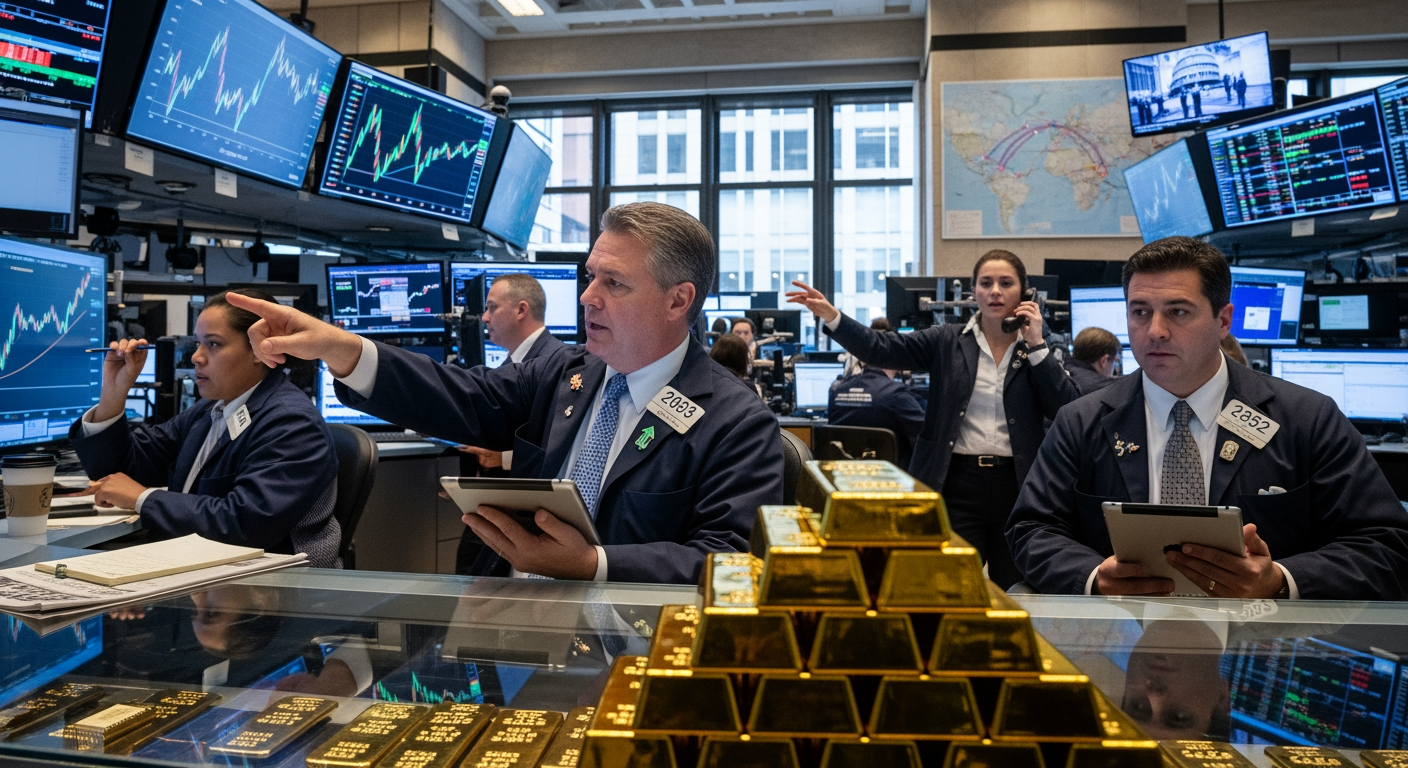
Gold is on a historic tear, surging to levels not seen since the 1970s. As of October 6, 2025, the yellow metal is flirting with the symbolic $4,000 per troy ounce mark, representing a spectacular gain of nearly 50% since the start of the year. This extraordinary performance is fueled by a potent mix of geopolitical uncertainty, trade tensions, and an unrelenting flight to safe-haven assets.
The situation in the United States, where a government shutdown has paralyzed the federal administration, is adding yet another layer of uncertainty to financial markets. Investors, deprived of the usual stream of official economic data typically released by government agencies, are flying blind in an environment already complicated by the trade war initiated by the Trump administration.
In India, one of the world’s largest gold consumers, this bullish trend is directly reflected in domestic prices. Today, 24-karat gold is trading around 12,000 rupees per gram in most major cities—a notable jump from the 11,775 rupees recorded at the beginning of October.
A Historic Rally Driven by Trump’s Trade War
Gold’s upward trajectory can be traced back to policy decisions made by the Trump administration. The trade war launched by the former president triggered a collapse in the dollar and pushed investors toward traditional safe-haven assets. This dynamic has created a virtuous cycle for gold, benefiting both from a weaker greenback and a growing appetite for security.
The precious metal is now posting its strongest annual gain since the 1970s, an era marked by oil shocks and runaway inflation. This historical comparison is no coincidence—it underscores the severity of today’s tensions and the depth of concern rippling through global financial markets.
FOMO Is Fueling the Surge
Beyond economic fundamentals, a psychological phenomenon is amplifying the rally: FOMO, or Fear of Missing Out. Many investors, witnessing gold’s spectacular rise, are piling in for fear of missing a historic opportunity. This self-reinforcing dynamic is helping to drive prices even higher.
Portfolio managers, typically cautious, are no longer hesitating to increase their exposure to gold. Specialized funds are seeing record inflows, while gold-backed ETFs are growing week after week.
The US Shutdown Paralyzes Economic Data
The partial shutdown of the US government is creating an information vacuum that’s particularly problematic for markets. Investors, who usually scrutinize every data release to anticipate price movements, are now deprived of essential statistics on employment, inflation, and economic growth.
This lack of visibility is naturally pushing market participants to adopt a defensive stance. Gold, the ultimate safe haven, is benefiting mechanically from this situation. Traders, unable to accurately gauge the health of the US economy, prefer to play it safe rather than take on unnecessary risk.
Ripple Effects Across Other Markets
The shutdown isn’t just depriving markets of data—it’s also exposing structural weaknesses in the US political system. This institutional instability is rattling international investors, who increasingly see gold as a credible alternative to dollar-denominated assets.
US equities, usually resilient to political turbulence, are showing signs of nervousness. Volatility is becoming the new normal, creating a favorable environment for defensive strategies—of which gold is a key component.
India Confirms the Global Trend with Soaring Prices
On the Indian market, which is traditionally sensitive to international price swings, the impact of gold’s rally is being felt in full force. Prices have risen almost continuously since early October, climbing from 11,775 rupees per gram for 24-karat gold on October 2 to over 12,000 rupees today.
This upward trend is visible across all major cities, with some local variations due to regional tax differences. Mumbai, a major hub for precious metals trading, is posting slightly lower prices than Delhi, where local taxes drive up the final cost.
Festive Demand Supports Domestic Prices
With India’s festive season approaching—a time when gold buying traditionally surges—there’s an added boost to prices. Jewelers are anticipating strong demand despite the high prices, as Indian consumers continue to view gold as an essential investment.
Local analysts note that even at record highs, demand remains resilient. This strength is rooted in India’s deeply ingrained investment culture, where gold is seen as more than just an asset—it’s a store of value passed down through generations.
Central Banks Fuel Institutional Demand
Alongside the enthusiasm from private investors, central banks around the world are continuing to buy gold at a brisk pace. This institutional demand, less volatile than retail buying, is providing a solid foundation for gold’s price surge.
Monetary authorities, facing geopolitical instability and uncertainty over the future of the international monetary system, are diversifying their reserves by increasing their gold holdings. This move away from the US dollar is accelerating in the current climate of trade tensions.
Strategic Reserve Diversification
Emerging markets, in particular, are actively accumulating gold. This strategy is part of a broader effort to reduce dependence on the US financial system and shield themselves from economic sanctions.
This structural demand, less sensitive to short-term fluctuations, is helping to put a solid floor under gold prices. It also explains why corrections, when they do occur, tend to be limited in both scope and duration.
Inflation Pressures and Monetary Policy: A Volatile Mix
The current macroeconomic environment has all the ingredients for a continued gold rally. The US producer price index is flashing warning signs, with a sub-index hitting 69.4 points in September—its second-highest level since October 2022.
This resurgence of inflationary pressures comes at a time when central banks are struggling to maintain credibility. Years of easy monetary policy have created a glut of liquidity that’s now flowing into tangible assets like gold.
The Limits of Conventional Monetary Policy
In this environment, central banks find themselves in a bind. Raising rates to fight inflation risks triggering a recession, while keeping policy loose would only stoke further price pressures.
This monetary stalemate is making gold even more attractive. While it doesn’t generate yield, gold preserves purchasing power over the long term. In a world where real interest rates are turning negative, that’s a major advantage.
Outlook and Risks to Watch
A look at the fundamentals suggests conditions remain favorable for gold’s continued rise. Ongoing geopolitical tensions, political instability in the US, and renewed inflationary pressures all provide lasting tailwinds.
However, several risks could disrupt this upward trajectory. A swift resolution to the US government shutdown, accompanied by a restoration of confidence in institutions, could trigger a technical correction. Likewise, an unexpected strengthening of the dollar against other major currencies would put downward pressure on gold prices.
Medium-Term Scenarios
In the base case scenario, gold could continue its climb toward $4,200–$4,500 an ounce by year-end, driven by persistent uncertainty and strong institutional demand. This path assumes, however, that there are no major shocks that fundamentally alter the geopolitical landscape.
Conversely, a gradual normalization of trade and political tensions could see prices consolidate around current levels, with fluctuations between $3,800 and $4,100 an ounce.
A New Era for Precious Metals Investing
This historic gold rally may well mark the dawn of a new era for precious metals. After decades of relative stability, the return of geopolitical volatility and major macroeconomic imbalances is restoring gold’s luster.
For investors, this environment calls for a complete reassessment of asset allocation strategies. Long considered a marginal defensive play, gold is reclaiming a central role in diversified portfolios. This structural shift could persist well beyond the resolution of today’s crises.
The key takeaway from this extraordinary sequence is the reaffirmation of gold’s irreplaceable role as the ultimate safe haven. In an increasingly uncertain world, where traditional benchmarks are faltering, the yellow metal continues to offer the stability and security that conventional financial assets can’t guarantee. This reality, underscored by recent events, is likely to permanently reshape how wealth managers and individual investors approach this age-old asset.
---
❓ FAQ - Frequently Asked Questions
1. Why has gold surged to nearly $4,000 an ounce this year?
According to the article, gold’s near-$4,000 per troy ounce level and roughly 50% year-to-date rise are driven by a mix of geopolitical uncertainty, trade tensions, and a flight to safe-haven assets. The trade war launched by the former U.S. president contributed to a collapse in the dollar, reinforcing demand for gold. A U.S. government shutdown has created an information vacuum by halting key economic data releases, pushing investors to adopt a defensive stance. Psychological forces add momentum: FOMO (Fear of Missing Out) is pulling more investors in as prices climb. Institutional participation is strong too, with portfolio managers increasing exposure, record inflows into specialized funds, and steady growth in gold-backed ETFs. Central banks are also buying at a brisk pace, and inflation pressures alongside a challenging monetary policy backdrop are making gold more attractive as a store of value.
2. What is a ‘safe-haven’ asset, and why is gold viewed this way?
The article characterizes gold as the “ultimate safe haven,” meaning it offers stability and security when traditional financial assets falter. In periods of geopolitical stress, market volatility, or institutional uncertainty—like during the current trade tensions and U.S. government shutdown—investors adopt defensive strategies. Gold benefits mechanically in such environments because it preserves purchasing power over the long term and is less tied to the performance of any single economy or currency. With conventional benchmarks under strain and real interest rates turning negative, gold’s role as a defensive component in diversified portfolios is being reaffirmed. This is why the current backdrop is pushing both individual investors and wealth managers to reassess asset allocation and give gold a more central role.
3. How is the U.S. government shutdown affecting markets and gold?
The shutdown has paralyzed parts of the federal administration, cutting off the usual stream of official data on employment, inflation, and growth. This information vacuum deprives investors of crucial signals, forcing them to “fly blind.” As a result, market participants are adopting a defensive stance, which benefits gold. The shutdown also highlights structural weaknesses in the U.S. political system, rattling international investors and increasing gold’s appeal relative to dollar-denominated assets. U.S. equities are showing signs of nervousness, with volatility becoming the new normal—an environment that favors defensive strategies where gold plays a key role. A swift resolution and restored confidence could trigger a technical correction in gold, but as long as uncertainty persists, the shutdown supports the metal’s strength.
4. What role did the Trump-era trade war play in gold’s rally?
The article traces gold’s upward trajectory to policy choices from the Trump administration. The trade war launched by the former president contributed to a collapse in the dollar and pushed investors toward traditional safe havens like gold, creating a virtuous cycle of demand and price appreciation. This rally is the strongest annual gain since the 1970s, a period marked by oil shocks and runaway inflation. The historical parallel underscores the severity of current tensions and the depth of concern across global markets, reinforcing gold’s appeal amid macroeconomic and political uncertainty.
5. What is FOMO, and how is it influencing gold prices?
FOMO stands for Fear of Missing Out. The article explains that beyond fundamentals, many investors are buying gold because they fear missing a historic opportunity as prices surge. This behavior is self-reinforcing: rising prices attract more buyers, which pushes prices higher still. Portfolio managers are increasingly increasing exposure, specialized funds are seeing record inflows, and gold-backed ETFs are growing week after week. This momentum component adds to the fundamental drivers—such as geopolitical risk, a weaker dollar, and institutional demand—helping sustain the rally.
6. How are gold prices evolving in India, and why do cities differ?
India, a major gold consumer, is mirroring the global uptrend. As of today in the article’s timeframe, 24-karat gold is around 12,000 rupees per gram, up from 11,775 rupees on October 2. Prices are rising across major cities, with local variations driven by regional tax differences. Mumbai, a key trading hub, shows slightly lower prices than Delhi due to local taxes that raise final costs there. Festive-season demand—traditionally a period of strong gold buying in India—is providing added support, with analysts noting resilient demand even at record highs. This reflects India’s deeply rooted investment culture where gold is viewed as a store of value passed down through generations.
7. How are central banks influencing gold’s price?
Central banks are buying gold at a brisk pace, providing a solid foundation beneath prices. Amid geopolitical instability and uncertainty over the international monetary system, monetary authorities are diversifying reserves by increasing gold holdings and reducing reliance on the U.S. dollar. Emerging markets are particularly active, aiming to lessen dependence on the U.S. financial system and shield against economic sanctions. This structural, less-volatile demand helps put a floor under gold prices and contributes to corrections being limited in scope and duration.
8. What do inflation pressures and monetary policy mean for gold?
The article notes renewed inflation signals: a U.S. producer price index sub-index reached 69.4 in September, the second-highest since October 2022. Central banks face a dilemma—raising rates risks recession, while staying loose may fuel more inflation. After years of easy policy, abundant liquidity is flowing into tangible assets like gold. In this setting, gold is attractive because it preserves purchasing power over the long term. With real interest rates turning negative, the opportunity cost of holding non-yielding gold diminishes, reinforcing demand for the metal.
9. What risks could derail the current gold rally?
The article highlights two primary risks. First, a swift resolution of the U.S. government shutdown—if it restores confidence in institutions—could prompt a technical correction. Second, an unexpected strengthening of the U.S. dollar against major currencies would put downward pressure on gold. More broadly, any major shock that fundamentally alters the geopolitical landscape could change the demand dynamics. While the base case remains supportive due to persistent uncertainty and strong institutional demand, these factors could interrupt or temper the upward trajectory.
10. What is the outlook for gold prices into year-end?
In the base case, the article sees gold continuing toward $4,200–$4,500 an ounce by year-end, supported by ongoing geopolitical tensions, U.S. political instability, renewed inflation pressures, and robust institutional demand. If trade and political tensions gradually normalize, prices could consolidate around current levels, fluctuating between $3,800 and $4,100 an ounce. These scenarios assume no major shocks that fundamentally change the geopolitical backdrop.
11. What should investors consider for their portfolios now?
The article suggests this environment calls for a reassessment of asset allocation. With volatility rising and conventional benchmarks faltering, gold is reclaiming a central role in diversified portfolios, shifting from a marginal defensive play to a core component. Defensive strategies are in favor, and gold’s ability to offer stability and preserve purchasing power stands out amid negative real rates, data uncertainty from the U.S. shutdown, and broader geopolitical risks. Investors should also be aware of the identified risks—such as a stronger dollar or a swift resolution to the shutdown—that could trigger a correction.
12. Why might this rally mark a new era for precious metals investing?
The article argues that the return of geopolitical volatility and large macroeconomic imbalances is restoring gold’s luster after decades of relative stability. Strong structural demand from central banks, persistent uncertainty, and a challenging monetary policy backdrop are elevating gold’s importance in portfolios. This shift appears durable, potentially lasting beyond today’s crises. The key takeaway is the reaffirmation of gold’s irreplaceable role as the ultimate safe haven, offering stability and security that conventional financial assets may not guarantee in an increasingly uncertain world.